Western Conference Finals Preview – The Last Best Hope

Basketball, Sports, Uncategorized

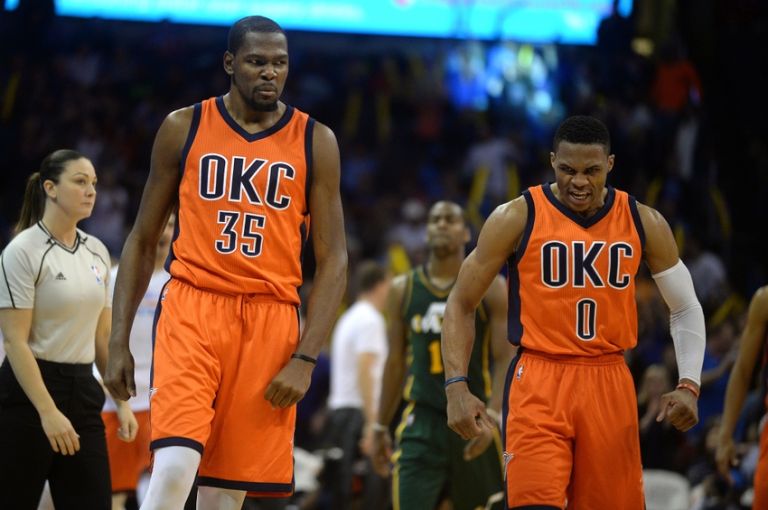
kevin-durant-russell-westbrook-nba-utah-jazz-oklahoma-city-thunder-768x0

All season, as Billy Donovan struggled with his lineups and seemed slow to an impatient audience to adapt his coaching strategies to the professional game, it felt like we were steamrolling toward a Spurs – Warriors super-series to close the Western Conference playoffs. What we’re getting instead is a direct result of Donovan’s surprising usurpation of his own glaring faults – he’s finally found his lineups and figured out his substitution patterns, and the series that we’re now treated with might not be what we expected, but it should certainly be what we prefer. Oklahoma City, in the form Donovan now presents us, will give Golden State a better series than the suddenly geriatric Spurs were capable of, and it’s not even close.

Consider all the intriguing lineup permutations, the number of peak-level superstars that will be on the court at any given moment, the Small vs. Big philosophical chess match – and the minor fact of the atmospheric level of entertainment that we were gifted with each time the Warriors and Thunder played during the regular season. The Spurs won 67 games, they’re the best 2-Seed probably ever, and they couldn’t have offered as much in the Western Conference Finals as we’re getting from the Thunder. Pop’s Spurs became the inverse of every team he’s tried to construct and prepare in his career – great in the regular season, and visibly exhausted as they progressed through the playoffs. For maybe the first time in his career, Pop’s timing was off – his team peaked too early.

The Thunder hit their stride in the 4th Quarter of Game 5, and their coherence carried them through a Game 6 blowout and now into the path of one of the best teams we’ve ever seen. As expected, Russell Westbrook’s gear hasn’t slowed for a single second of these playoffs – if you cut to a live shot of him right now, at this very moment, he’s probably sprinting incomprehensibly around the perimeter of the empty parking lot at the Oracle, wearing capri corduroys and a leather tunic, literally running down the time until tip-off. We know all about his style of play – the speed and control in transition, the offensive rebounding, nagging and frustrating defensive intensity – he controls the game, he forces you to ogle him closely every moment that he’s on the floor. He’s not his team’s best player, but he is its constant navigator – always at the yolk, steering fearlessly as best he can.

Sometimes, though, even he loses control of the wheel. To open the second half of Game 5 against the Spurs, Westbrook tried to take complete control of the game, manhandling the offense and his team fell down twelve points – toward the end of the quarter, his over/under was a team-worst minus-13. This is the side of Westbrook that the Thunder have to be concerned about – when he started killing the half-court offense with elbow jumpers and pull-up threes with 20 seconds left on the shot clock, the Thunder fell down to an offensively-challenged Spurs team by 12 points. If the same thing happens against the Warriors, they’ll fall down by 30. Westbrook eventually played his way out of his slump in the 4th Quarter of Game 5, but there won’t be time against the Warriors for him to work it out on his own – if his shot isn’t falling, he can’t resort to Hero Ball. He can’t try to one-up Durant in this series – the offense will flow through Westbrook, but if the Thunder are going to keep pace with Steph and Klay, Durant has to take the highest volume of the Thunder’s shots. Durant is simply the more efficient shooter, and the Thunder can’t afford a lot of missed baskets – the Warriors certainly won’t have many.

Westbrook’s value in this series may be psychological, and on the defensive end of the floor. We’ve seen that if there’s any real way to actually derail Steph Curry, it’s to knock him around a little, a defense used most effectively by Chris Paul. Westbrook will likely be asked to direct his top-speed motor directly into Steph’s grill, to test his sore ankles with heavy contact, and whether Westbrook is able to frustrate Curry into submission or whether he merely amps him up will be the barometer of his individual success in this series.

Russ vs. Steph is the most intriguing individual matchup of the series, but the strategic, five on five gameplans that Kerr and Donovan will employ are still a mystery. We know that the Warriors are going to roll out their Lineup of Death with Draymond at center, but we don’t know how Donovan will choose to combat it. The choice may actually hinge on the almost-forgotten Serge Ibaka, who can play center in the Thunder’s own small lineup, with Waiters or Foye the third guard. The Thunder’s offensive efficiency ratings with this lineup are astronomical, but they’ve utilized it surprisingly little this season, and hardly at all in their three regular season matchups with the Warriors.

Regardless of whether Donovan had intended to save his small lineup for a matchup with the Warriors, his decision now that the series has come is complicated by the emergence of Kanter and Adams in a markedly big lineup that would have its own advantages against the Warriors’ non-Death personnel. The Thunder are the best rebounding team in basketball, and Kanter and Adams are going to wear Draymond out under the basket, which means that Bogut, Ezeli, and Speights will be counted on for productive minutes in volume. Advantage: Thunder.

The Thunder are the team in the West most capable of beating the Warriors in a seven game series, but it doesn’t matter. Most capable doesn’t, in this case, equate to “capable.” Kanter and Adams are going to push the Warriors’ bigs around on the glass, but superior rebounding is only an advantage if the other team is missing shots. Waiters and Foye have had great postseason roles as third and fourth guards, but they’ll be going against the best Second Unit in basketball, and will be shut down by Livingston and Iguodala. Russ will have long stretches of unstoppable glory, but he’ll also have to know when to abandon his Hero Ball instincts and defer to Durant, but he doesn’t have a conceding gland in his body. The Thunder are scorching, they disposed of the Spurs and gave us the best Western Conference Finals matchup we could hope for when one of the teams is almost literally unbeatable, but the outcome still isn’t in doubt – the Thunder are peaking and the gap has closed, but I’ll still take the Warriors in 7.
The Overwhelming Case Against Phil Jackson

Basketball, Sports
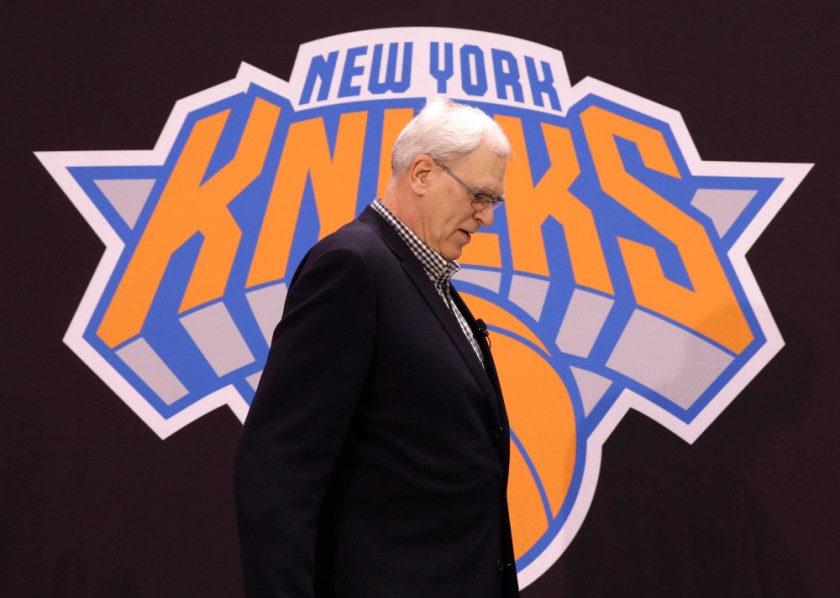
AP KNICKS JACKSON BASKETBALL S BKN FILE USA NY

(AP Photo/Seth Wenig, File) 

Phil Jackson wants us to know that he is unwavering in his philosophical convictions. He is confident in his executive process beyond all reason. He is insular beyond justification. He hears the criticisms in our exasperated pleas, he understands their basis, and he is ignoring them: his next head coach will be one of his “friends who runs the triangle.” It’s inexplicable and he knows it, but rather than denigrate and abandon the doctrine synonymous with his own eroding reputation, he ploughs ahead toward certain failure.

The Phil Jackson coaching tree is a desiccated oak struck by lightning seventeen times before finally cut up to make replacement paneling for a 1982 Aerostar. It’s the sapling in an orange grove infected with Dutch Elm’s disease, and the next head coach of the Knicks will be plucked from amongst its virulent fruit.

Rambis, Shaw, Cartwright, Fisher – that’s not a tree, it’s a dissipated cemetery.

The bankruptcy of talent presented by each of Phil’s assistants who have ascended to a head coaching position is consistent and staggering, but one of these objective and abject failures will soon be offered maybe the most valued coaching job in the NBA. They have one credential that overrides all of their losses and their recorded inabilities to grow and connect with players. They know Phil. That’s it. They just know him.

There’s only one person in the solar system who thinks Kurt Rambis is qualified to be the head coach of anything other than an eighth grade C.Y.0. rec team, and it surprises no one that one savior clinging to irrational belief is Phil Jackson. Rambis appears poised to lead this ship back to the bottom of the ocean, set to be the permanent head coach almost by default, as Carmelo Anthony is in front of every microphone he can find begging for there to even be a process in place for hiring the next head coach – apparently one doesn’t at present exist.

That Tom Thibodeau, the most coveted head coach available this offseason, reached out to Phil with an interest in the Knicks’ vacancy and was mystifyingly rebuffed should actually not be all that mystifying considering Phil’s unequal opportunity hiring methodology. Ignoring intriguing candidates – this year it was Thibs, Scotty Brooks, and Jeff Van Gundy — is a staple of Phil’s executive agenda. Before hiring Derek Fisher in 2014, Stan Van Gundy expressed interest in the vacancy and was similarly treated as a nonentity. Fisher was hired, fresh off the court and without any experience as a coach of any kind at any level, and was, predictably, an instant failure, buried now in his rightful plot in the Phil Jackson Coaching Cemetary. Meanwhile, Stan Van Gundy is in Detroit rebuilding the Pistons and this year was in the playoffs while the Knicks checked back in to their reserved room in the league’s basement with their second miserably inadequate head coach in as many years, looking possibly now for a third.

There has quickly emerged a pattern in Phil’s strategy that Knicks fans have found unacceptable, a modus operandi that, even considering his own legend as a head coach, disqualifies him from his front office position and merits his immediate termination. That’s not hyperbole. Phil Jackson will allow the Knicks to lose, and lose stupendously, before he will adapt the antiquated ideology that comprises his own identity in the league.

It’s 2016 and the Triangle is dead, but Phil Jackson will trot its corpse onto the floor of Madison Square Garden and let the Knicks be steamrolled rather than abandon it. He will let the Knicks and their fans suffer, but he will not let suffer his Triangle.

He doesn’t hide that the Triangle is prioritized over winning, over the organization’s growth and development, over its fans – he wants you to feel the Triangle’s importance because it is so closely connected with his own. He responded to another 30-win season under the guidance of a head coach whose resume contains only derision, one disliked by Knicks players and ridiculed around the league, by hosting a Triangle camp in tandem with that objectively miserable head coach. He wants you to know: the Knicks are not giving up on the Triangle. He knows you hate it. He knows the taste is sour, he knows it’ll make you sick, but he’ll serve it to you three times a day anyway.

The league’s tempo and style have moved away from most of the foundational elements of the overly complex, borderline impossible to understand Triangle Offense – the Triangle wants the ball to flow through a center in the post, and the NBA is currently dominated by speedy guards and centers who can stretch away from the basket; the triangle wants the ball in everyone’s hands, and players now are taught to use back screens and cuts to free up space on the weak-side away from the ball; the Triangle’s only use for three point shooting is to free up opportunities in the post, but the present preponderance of perimeter shooters is rendering elbow jumpers and points in the paint to their least valued position in NBA history – it’s hard to beat teams who score three points at a time by staying under the basket and only scoring two.

And on, and on, and on.

The Triangle is intuitive, well-reasoned, effective historically when smart, talented players buy-in – it contains pieces that still work well, but the game has moved on from the Triangle as a complete, self-contained system. It’s not surprising that the league’s current two best teams – the Spurs and Warriors — have adopted the Triangle’s most effective elements and married them to the realities of the 2016 NBA. They utilize quick passes to open shooters on the weak side, safety valves against defensive pressure, back screens to create mismatches off the ball – the ball movement used by the Spurs and Warriors is very much based on Triangle philosophies, but they don’t encourage the inhibiting of athletic reflex and one-on-one intuition that the Triangle demands.

With his refusal to abandon or adapt his system, the cap space that Phil has worked to secure this offseason may be, ironically, useless to him. Consider that the guy who invented the Triangle required his players to sit for two years of study before even being prepared to step foot on the court in a game situation — attracting the offseason’s best free agents to come play in an antiquated, complex system with no immediate promise of success or understanding, for a coach who’s never won, will be no small order.

“KD! It’s Phil again. I know you’ve hung up on me fourteen times in a row, but did you hear about the Triangle camp that I ran with Kurt Rambis?”

“Sorry for coming to your house again uninvited, Demar, but do you really understand how many elbow jumpers the Triangle will open for you?”

“All right, Andre, I know you’re worried about Rambis’ career win percentage, so I faxed you a chart of the 598 passes available from the post in the Triangle.”

Even Phil’s greatest personnel coup was almost inhibited by Triangle wisdom. Picking Kristaps Porzingis in last year’s draft is probably the only reason Phil still has a job, but the primary reason he took KP fourth was because Jahlil Okafor – the Duke center whose post-scoring and interior passing caused instinctive drooling whenever Phil imagined him as his Triangle center – was taken one spot ahead of the Knicks and by all pre-draft analysis would have been Phil’s pick if he’d fallen to them.

He didn’t, and Porzingis was a smart, forward-thinking risk that’s so far paid off, but his severe drop in production as the season progressed is a legitimate concern – as he became more familiar with the system, with the Triangle, his numbers actually decreased. The brilliance of taking Porzingis is negated if you don’t have the intelligence, or the humility, to use him correctly. He represents the ideal Stretch 5, the most coveted position in today’s NBA, but unfortunately for Porzingis, the Stretch 5 hadn’t been considered in 1962 when the thousands of diagrams that comprise the Triangle were created, and so it will have no place on Phil Jackson’s Knicks.

Phil is married to the Triangle – it’s part of his basketball identity, it’s the reason he’s allowed to take credit for winning championships with Michael and Scottie and Kobe and Shaq. He can’t let it go – if he admits its deficiencies, he’ll be admitting that his role on those great teams should be properly diminished, and his own myth will weaken. The only coaches available to him, then, are coaches who both understand the triangle well enough to implement it and are masochistic enough to actually do so – a miniscule list of names rightfully discarded by the league as objectively inadequate. The Knicks under Phil Jackson are therefore doomed to run an obsolete system for a coach whose never won – they are doomed to lose for as long as he remains employed, and so the only thing currently more puzzling than the Triangle is the delay in his dispensation.