Memo To Dolan: Ban Dolan

Basketball, Sports

The reaction from the beleaguered community of Knicks faithful to the forced removal and indefinite ban from Madison Square Garden of Charles Oakley, their combatant hero still, has surprised no one with the sharpness and continuity of its outrage. When Oakley was dragged into the Garden tunnel in the early stages of what would be a third straight loss in a season that is marching dismally into the gloom, Knicks fans immediately translated the symbolism – it was another plank burned by James Dolan on the bridge back to the team’s glorified past.

When you whitewash history, you’re left to think only of the present, and for a franchise mired in nearly two decades of uninterrupted failure, fans aren’t exactly eager to dwell on current events. Understand what these fans mean: when they chanted “We want Oakley” at MSG Friday night, they were begging their organization, beginning with their owner, to allow their memories to have relevance in the present. Nostalgia is the most positive emotion these fans have felt this millennium – in its absence, there is only harsh reality.

When you take away Oakley, you leave Marbury, Isiah, Curry, Francis, Brown, Stoudemire.

Surprising to no one, the guy holding the gasoline up to this most recent fire is James Dolan. Even considering the backlash that’s followed, it’s not crazy to believe that Oakley owns some culpability in his forced removal Wednesday night – that Oakley would have been thrown out and banned from the Garden if he’d simply been shaking hands on his way to his seat seems unreasonable, even for the Knicks.

But it’s also reasonable to believe that considering the franchise’s adversarial relationship with Oakley, Dolan, expecting his appearance Wednesday night, may well have been looking for a reason to embarrass the former star, and he’s certainly gone out of his way to do just that. Even if Dolan believed that facts on the ground Wednesday night merited Oakley’s eviction, there were ways for Dolan to execute this directive with a subtle flash rather than a mushroom cloud. Oakley could have quietly been escorted from the arena during a timeout, during halftime – instead, Dolan had him carried out during live game action, with cameras rolling, early in the first quarter.

He could have let the controversy die 24 hours later, but instead he chose to distract Knicks fans from the sewer their season is sinking into with an effusion of bile strictly his own, alleging that Oakley is a violent alcoholic in an interview that will be written into law school curricula as the textbook definition of public slander.

I’ll politely ask James Dolan to spare us his moral outrage on this subject. He contends that he hopes Oakley will “seek help” for his troubles – should he be reminded that Anucha Browne Sanders turned to him for help in 2006, when she alleged that Isiah Thomas sexually harassed her and was, subsequent to her report, fired by Dolan from her position as a Knicks vice president for marketing? Dolan settled a lawsuit with Browne Sanders for $11.5 million.

James Dolan will no longer welcome Oakley to the Garden for undisclosed, legally unproven poor behavior, but every day he warmly welcomes Derrick Rose, whose testimony in a sexual assault case against him revealed his thoughts on the nature of reasonable consent:

Q: So they just said, ‘Hey, it’s the middle of the night, let’s go to Plaintiff’s house,’ and they never gave you a reason why they wanted to go over there?

Rose: No, but we men. You can assume.

Q: I’m sorry?

Rose: I said we men. You can assume. Like we having to go over to someone’s house at 1:00, there’s nothing to talk about.

The ‘we men’ defense for sexual assault is more than welcome in Dolan’s Garden. No official intervention is needed for Derrick Rose. But for Oakley? Dolan wishes someone would step in.

Asking James Dolan to carry himself with even a modicum of self awareness would be like asking a tree to do a backflip. The wall between Dolan and reality will never fracture, so Knicks fans are forced to bear it alone. Their franchise is without hope, at least until it’s their owner who is dragged from the Garden, never to return.

Who Is The Captain Of This Ship

football, nfl, Sports, Uncategorized

By definition, a Raider takes. He plunders, he pillages, he loots, he overbears. He decides on a trophy and he has it for himself, allows no one to pry it away.

The Raiders we saw in Tampa this afternoon were a direct contradiction of their branded title – they were charitable givers of the highest degree. They had territory and threw it away for nothing. They were aggressive, but they were weak. Their outright stupidity belied their instinctive decisiveness and pulled the curtain delicately concealing a crucial component of their identity:

Forget their record. Forget their talent. Forget their explosiveness. The Raiders are breaking the sound barrier with no one at the yoke. There is no one guiding this team.

A team under capable command doesn’t give up three penalties that create first downs on a fourth quarter drive that leads to his opponent taking a late lead. A competent tutor doesn’t allow his charges to give up five yard penalties on two separate First and Goal plays at the 2 yard line, including once on the team’s penultimate drive in regulation, trailing by a touchdown. The Raiders have been carried far this year aboard the tide of their considerable talent, that’s true. But athletic skill can be attributed to many things – indiscipline is the result of only one.

The Buccaneers that faced these headless horsemen from Oakland deserved by the sake of their own degenerate play to be utterly decimated on Sunday, and perhaps would have been against an opponent with even a modicum of situational coherence. Jameis Winston lost track of his star receiver Mike Evans after a promising first quarter that saw Winston standing strong in a crowded pocket, making sterling passes on the run against a secondary weakened after Sean Smith left with an early arm injury.

Winston’s accuracy eroded, and with it his team’s early ten point lead. Staked to a 17-10 lead after a miraculous-seeming nearly mistake-free third quarter, the Raiders regressed in the Fourth. It doesn’t matter that they came back to tie and force overtime after blowing the lead. To a certain extent, it doesn’t matter even that they were able to slide through a Bucs secondary trying to tackle people as if it were by and large armless to a victory late in overtime. When evaluating the long-term prospects of this team — when determining their ceiling this season against franchises that play like adults — what matters are the inexcusable, avoidable penalties – the countless illegal formations, 12 men on the field, holding on punts that were launched into the endzone – the plays that would have destroyed them against a team anywhere above sub-mediocre, which is an optimistic valuation of the Buccaneers.

Del Rio will get credit for going for it on 4th and 4 in overtime. He doesn’t deserve it – or, at the very least, the value of that credit doesn’t come close to exceeding the weight of his team’s mistakes. 4th and 4 on the opponent’s side of the field approaching two minutes left in overtime against an offense that had mustered only three-and-outs in the extra session – to punt would have been laughable. If you want to give Riverboat Jack credit for doing one not-laughable thing this afternoon, go ahead – I won’t.

Here is an abridged list of things that this obvious Fourth Down decision doesn’t excuse:

  • Crabtree turning a 3rd and 1 to 3rd and Long, which wouldn’t be converted, with a taunting penalty.
  • Delay of Game on 1st and Goal from the 3.
  • Offensive Pass Interference in the endzone by Crabtree, negating a touchdown.
  • Illegal shift on 1st and Goal from the 2, trailing by a touchdown late in the 4th
  • Hands to the Face by a receiver in overtime, in field goal range.
  • False Start on 3rd and 16 in overtime, pushing the Raiders out of FG range.
  • Holding on an overtime punt that was sailing into the endzone for a touchback.
  • Holding to negate a 42 yard pass play in overtime.
  • An NFL record 23 penalties for 200 yards.

To summarize, THIS game went to overtime:


Oakland massively outperformed an overwhelmed opponent, and still had to scrape victory from some of the most noxious effluvium we’ve ever seen in professional football. The Raiders learned today the very limit that an abomination can still be carried forth to victory – they should have learned, though, that they won’t beat anyone better than this anemic, unremarkable Bucs team with disgraces like today’s. Oakland’s brass can congratulate itself on its victory and its record, or it can hope to find a qualified mentor for its collection of supreme and willfully boneheaded talent. Right now, there isn’t one.

The Parquet Regards – Week 3

football, nfl, Sports

Some notes on this week’s arbitrary league alignment:

  • Houston has been gifted a glorious opportunity in Week 3 to establish itself as a relevant power in the AFC.  We know that New England is down to the Pizza Hut Delivery Guy on its QB depth chart, but the general perception is that Houston is still comparatively weaker overall.  It’s Houston’s offense that’s capable of outrunning New England’s defense — this is Glock Osweiler’s moment to either legitimize his placement in the league’s quarterback hierarchy or be glossed over as another 9-7 Houston plug-in.
  • If the Ryan Brothers make it past Week 4, I will have a lap band surgically implanted into my lower intestine just to have it immediately removed in their honor.  Lesson One for prospective NFL head coaches: Do not hire a relative for your coaching staff.  Lesson Two: Do not allow your players to meet with ownership in your absence.  Rex is steamrolling toward a scenario in which he has to choose to either fire his brother or go down with the ship himself — so far, he’s been willing to unfairly sacrifice his offensive coordinator.  We’ll see if he’s as willing to stand in solidarity with his brother in the unemployment line as he is in the buffet line.
  • The NFC South plays defense roughly as well as I recite poetry in Urdu while juggling a booming farm’s worth of twelve pound pork butts.
  • A lot of us not-so-bravely predicted that the Colts would be bad at football this year, and only a despicable few of us are pleased to watch unfold what we foretold as inevitable.  Andrew Luck is too smart to show us the fear that must lie underneath, but he’s dangerously close to entering the “Oh My God I’ve Entrusted My Once In a Generation Talent With A Bunch Of Incompetents” stage of his career, and it’s becoming objectively sad to watch.
  • The Browns are the Zodiac.

Here’s how we regard the teams before Week 3:

RANK TEAM W-L PD DVOA OFF DVOA DEF DVOA
1 Pittsburgh Steelers 2-0 +30 4 7 14
2 New England Patriots 2-0 +9 23 12 29
3 Arizona Cardinals 1-1 +31 2 8 4
4 Denver Broncos 2-0 +15 9 15 11
5 Carolina Panthers 1-1 +18 3 11 7
6 Houston Texans 2-0 +16 25 30 6
7 Minnesota Vikings 2-0 +12 12 26 3
8 Green Bay Packers 1-1 +1 15 25 10
9 New York Giants 2-0 +4 20 16 17
10 Cincinnati Bengals 1-1 -7 13 14 13
11 Kansas City Chiefs 1-1 -1 11 21 15
12 Seattle Seahawks 1-1 -4 8 27 1
13 Baltimore Ravens 2-0 +11 5 20 8
14 New York Jets 1-1 +5 17 5 26
15 Philadelphia Eagles 2-0 +34 1 9 2
16 Dallas Cowboys 1-1 +3 14 13 21
17 Oakland Raiders 1-1 -6 21 1 32
18 San Diego Chargers 1-1 +18 7 2 20
19 Detroit Lions 1-1 +3 6 3 27
20 Tampa Bay Bucs 1-1 -26 30 24 22
21 Atlanta Falcons 1-1 0 16 4 30
22 Tennessee Titans 1-1 -8 18 17 12
23 New Orleans Saints 0-2 -4 19 6 23
24 SF 49ers 1-1 +9 10 23 5
25 LA Rams 1-1 -22 28 32 9
26 Jacksonville Jaguars 0-2 -8 31 28 28
27 Indianapolis Colts 0-2 -18 22 10 31
28 Miami Dolphins 0-2 -9 27 22 18
29 Buffalo Bills 0-2 -12 26 19 25
30 Washington 0-2 -26 24 18 24
31 Chicago Bears 0-2 -24 29 31 16
32 Cleveland Browns 0-2 -24 32 29 19

More Washington Deadlock

football, nfl, Sports, Uncategorized

The respite from objective institutional failure for fans of Washington’s professional football team was meager, and is now over. The stink that has permeated through its organization – originating first with its very name and mascot and the inexplicably staunch defense of both, stretching to leadership mantras from ownership that over the years have vacillated between “Loyalty Is My Firewood” and “Welcome To The Team, We’ve Already Scheduled Your Office Locks To Be Changed Six Months From Now” – has, after one moderately deodorized season, made its way back onto the football field.

You like that, Mr. Snyder?

Two games into the season, Washington is showcasing a Tony Robbins-tier expert clinic in How To Miss The Playoffs In a Wretched Division Seven Months After Winning It. It’s true that we’re witnessing the humanizing of the once perplexingly immortal Kirk Cousins, but the team’s trajectory toward certain failure this season is for reasons beyond just their noodle-armed and displeasingly loud-talking quarterback.

The Broncos have showed us how to win with a quarterback who can only move his offense five yards at a time — the solution isn’t difficult to discern, but implementing it with success is nearly impossible. If you’re quarterback is bad, then all you have to do is be the best in the NFL at everything else.

Unfortunately for Washington, through two games their defense ranks tied for 26th in the league, shredded most recently by the rookie brigade from Dallas. They were eviscerated in Week One by backup septuagenarian DeAngelo Williams, which caused a strikingly noticeable over-commitment to try to stop Ezekiel Elliot in Week Two. Dallas noticed this game plan almost instantly, running three play action bootlegs in the first quarter that all led to wide open completions – on all three plays, Dak faked the handoff right, baiting the entire Washington front seven to abandon the left side of the field as a receiver ran free into the void. The defensive coaching staff didn’t adjust – after the first quarter, the same play was run at least three times more with the same result.

This has been a theme for Jay Gruden and his staff – the game plan is apparently etched in stone in the style of Babylonian law. On either side of the ball, it’s not changing, no matter how quickly it’s neutralized.

This is stubbornness at its most obvious and idiotic. Three times the Washington offense tried a fade in the red zone – a play that became ubiquitous and then solved and made futile by defenses something like twenty five years ago. The first two times Washington tried it, as it has been countless consecutive times through history, the fade was easily defended with a mildly bothered swat by the defense. Then, of course, Washington had to try it that third time. You’ll never guess what happened.

Asked after the game if Jay Gruden thought it was a bad idea to run an inoperative play three times in the red zone during a close game despite its repeated failure, Gruden replied with inexplicable annoyance that he’d run the fade three more times next week, if he had to.

Please don’t, Jay – trust us, you don’t have to.

We know that the obvious counterbalance to a weak quarterback is to invest in a deep defensive infrastructure. Josh Norman was Washington’s major acquisition to that end, and the rigidity of his placement in their defensive formation is dubious at best and evidence of strategic incompetence at worst.

After heavy criticism for constantly lining up away from Antonio Brown in Week One, Jay Gruden again didn’t flinch – the Cowboys were able to shake Norman off of Dez Bryant simply by motioning him to the opposite side of the field while Norman stayed still. Washington valued his skills at $50 million guaranteed, and in a game against a divisional rival, often used those skills to cover the likes of Geoff Swaim and Lance Dunbar. Dez Bryant, meanwhile, was able to choose his matchup, easily switching himself onto Bashaud Breeland, who led Washington in tackles primarily because he was torched, targeted, and torched again (repeat eight times).

This obstinacy from the coaching staff is already being grumbled upon in Washington’s locker room — of course, dissension is always neutralized by winning, the possibility of which is always only a week away – but for players to publicly bemoan their coaches this early in the season is unusual and ominous. The luster from last season’s surprise run has already almost completely worn off, and underneath it will be the reminder that Jay Gruden is a career 13-21 coach. No slack will be cut, especially by his players.

The Norman signing was Washington’s lone offseason splash meant to improve its defense, a big move, but one without compliment, probably because Washington presumed its offense to be in capable hands with Cousins. Through two games, Cousins has made what should have been a predictable regression – his inaccuracy is this season is perceptible as ever, but he threw a high number of interceptible passes last year as well, but low expectations and relative collapse by their divisional opponents helped to mask flaws that may have otherwise been more widely tracked. It’s not new that Cousins has a weak arm and is incapable of leading an offense downfield by chunks of more than ten yards – the same was the case last year, but Washington stumbled to a playoff birth, and they errantly relied on a hope of progression that is destined to be unfulfilled.

A wagon hitched to an inaccurate, mistake-prone quarterback; a weak defense; a coaching staff unwilling make obvious in-game adjustments; a resentful locker room – if you’re developing a collection of indicators of a losing season, this is almost a complete list. Washington’s professional football team features all of the above, and their fan base is facing one of the worst realities in sports – the almost immediate realization of dramatically unrealized potential.

The bright side: If things continue to go bad, maybe the team will consider a major scrub of its identity. Maybe, if things get ugly enough, they’ll finally rebrand.

Western Conference Finals Preview – The Last Best Hope

Basketball, Sports, Uncategorized

kevin-durant-russell-westbrook-nba-utah-jazz-oklahoma-city-thunder-768x0

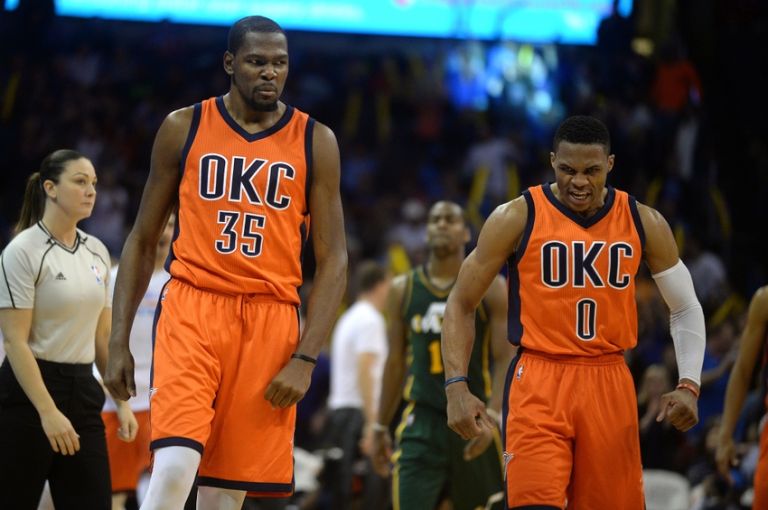
All season, as Billy Donovan struggled with his lineups and seemed slow to an impatient audience to adapt his coaching strategies to the professional game, it felt like we were steamrolling toward a Spurs – Warriors super-series to close the Western Conference playoffs. What we’re getting instead is a direct result of Donovan’s surprising usurpation of his own glaring faults – he’s finally found his lineups and figured out his substitution patterns, and the series that we’re now treated with might not be what we expected, but it should certainly be what we prefer. Oklahoma City, in the form Donovan now presents us, will give Golden State a better series than the suddenly geriatric Spurs were capable of, and it’s not even close.

Consider all the intriguing lineup permutations, the number of peak-level superstars that will be on the court at any given moment, the Small vs. Big philosophical chess match – and the minor fact of the atmospheric level of entertainment that we were gifted with each time the Warriors and Thunder played during the regular season. The Spurs won 67 games, they’re the best 2-Seed probably ever, and they couldn’t have offered as much in the Western Conference Finals as we’re getting from the Thunder. Pop’s Spurs became the inverse of every team he’s tried to construct and prepare in his career – great in the regular season, and visibly exhausted as they progressed through the playoffs. For maybe the first time in his career, Pop’s timing was off – his team peaked too early.

The Thunder hit their stride in the 4th Quarter of Game 5, and their coherence carried them through a Game 6 blowout and now into the path of one of the best teams we’ve ever seen. As expected, Russell Westbrook’s gear hasn’t slowed for a single second of these playoffs – if you cut to a live shot of him right now, at this very moment, he’s probably sprinting incomprehensibly around the perimeter of the empty parking lot at the Oracle, wearing capri corduroys and a leather tunic, literally running down the time until tip-off. We know all about his style of play – the speed and control in transition, the offensive rebounding, nagging and frustrating defensive intensity – he controls the game, he forces you to ogle him closely every moment that he’s on the floor. He’s not his team’s best player, but he is its constant navigator – always at the yolk, steering fearlessly as best he can.

Sometimes, though, even he loses control of the wheel. To open the second half of Game 5 against the Spurs, Westbrook tried to take complete control of the game, manhandling the offense and his team fell down twelve points – toward the end of the quarter, his over/under was a team-worst minus-13. This is the side of Westbrook that the Thunder have to be concerned about – when he started killing the half-court offense with elbow jumpers and pull-up threes with 20 seconds left on the shot clock, the Thunder fell down to an offensively-challenged Spurs team by 12 points. If the same thing happens against the Warriors, they’ll fall down by 30. Westbrook eventually played his way out of his slump in the 4th Quarter of Game 5, but there won’t be time against the Warriors for him to work it out on his own – if his shot isn’t falling, he can’t resort to Hero Ball. He can’t try to one-up Durant in this series – the offense will flow through Westbrook, but if the Thunder are going to keep pace with Steph and Klay, Durant has to take the highest volume of the Thunder’s shots. Durant is simply the more efficient shooter, and the Thunder can’t afford a lot of missed baskets – the Warriors certainly won’t have many.

Westbrook’s value in this series may be psychological, and on the defensive end of the floor. We’ve seen that if there’s any real way to actually derail Steph Curry, it’s to knock him around a little, a defense used most effectively by Chris Paul. Westbrook will likely be asked to direct his top-speed motor directly into Steph’s grill, to test his sore ankles with heavy contact, and whether Westbrook is able to frustrate Curry into submission or whether he merely amps him up will be the barometer of his individual success in this series.

Russ vs. Steph is the most intriguing individual matchup of the series, but the strategic, five on five gameplans that Kerr and Donovan will employ are still a mystery. We know that the Warriors are going to roll out their Lineup of Death with Draymond at center, but we don’t know how Donovan will choose to combat it. The choice may actually hinge on the almost-forgotten Serge Ibaka, who can play center in the Thunder’s own small lineup, with Waiters or Foye the third guard. The Thunder’s offensive efficiency ratings with this lineup are astronomical, but they’ve utilized it surprisingly little this season, and hardly at all in their three regular season matchups with the Warriors.

Regardless of whether Donovan had intended to save his small lineup for a matchup with the Warriors, his decision now that the series has come is complicated by the emergence of Kanter and Adams in a markedly big lineup that would have its own advantages against the Warriors’ non-Death personnel. The Thunder are the best rebounding team in basketball, and Kanter and Adams are going to wear Draymond out under the basket, which means that Bogut, Ezeli, and Speights will be counted on for productive minutes in volume. Advantage: Thunder.

The Thunder are the team in the West most capable of beating the Warriors in a seven game series, but it doesn’t matter. Most capable doesn’t, in this case, equate to “capable.” Kanter and Adams are going to push the Warriors’ bigs around on the glass, but superior rebounding is only an advantage if the other team is missing shots. Waiters and Foye have had great postseason roles as third and fourth guards, but they’ll be going against the best Second Unit in basketball, and will be shut down by Livingston and Iguodala. Russ will have long stretches of unstoppable glory, but he’ll also have to know when to abandon his Hero Ball instincts and defer to Durant, but he doesn’t have a conceding gland in his body. The Thunder are scorching, they disposed of the Spurs and gave us the best Western Conference Finals matchup we could hope for when one of the teams is almost literally unbeatable, but the outcome still isn’t in doubt – the Thunder are peaking and the gap has closed, but I’ll still take the Warriors in 7.

The Overwhelming Case Against Phil Jackson

Basketball, Sports
AP KNICKS JACKSON BASKETBALL S BKN FILE USA NY

(AP Photo/Seth Wenig, File) 

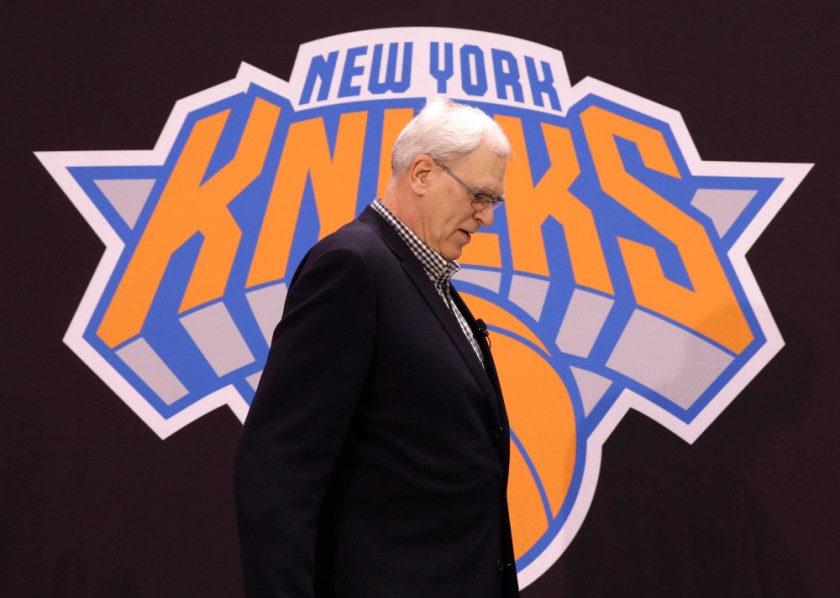
Phil Jackson wants us to know that he is unwavering in his philosophical convictions. He is confident in his executive process beyond all reason. He is insular beyond justification. He hears the criticisms in our exasperated pleas, he understands their basis, and he is ignoring them: his next head coach will be one of his “friends who runs the triangle.” It’s inexplicable and he knows it, but rather than denigrate and abandon the doctrine synonymous with his own eroding reputation, he ploughs ahead toward certain failure.

The Phil Jackson coaching tree is a desiccated oak struck by lightning seventeen times before finally cut up to make replacement paneling for a 1982 Aerostar. It’s the sapling in an orange grove infected with Dutch Elm’s disease, and the next head coach of the Knicks will be plucked from amongst its virulent fruit.

Rambis, Shaw, Cartwright, Fisher – that’s not a tree, it’s a dissipated cemetery.

The bankruptcy of talent presented by each of Phil’s assistants who have ascended to a head coaching position is consistent and staggering, but one of these objective and abject failures will soon be offered maybe the most valued coaching job in the NBA. They have one credential that overrides all of their losses and their recorded inabilities to grow and connect with players. They know Phil. That’s it. They just know him.

There’s only one person in the solar system who thinks Kurt Rambis is qualified to be the head coach of anything other than an eighth grade C.Y.0. rec team, and it surprises no one that one savior clinging to irrational belief is Phil Jackson. Rambis appears poised to lead this ship back to the bottom of the ocean, set to be the permanent head coach almost by default, as Carmelo Anthony is in front of every microphone he can find begging for there to even be a process in place for hiring the next head coach – apparently one doesn’t at present exist.

That Tom Thibodeau, the most coveted head coach available this offseason, reached out to Phil with an interest in the Knicks’ vacancy and was mystifyingly rebuffed should actually not be all that mystifying considering Phil’s unequal opportunity hiring methodology. Ignoring intriguing candidates – this year it was Thibs, Scotty Brooks, and Jeff Van Gundy — is a staple of Phil’s executive agenda. Before hiring Derek Fisher in 2014, Stan Van Gundy expressed interest in the vacancy and was similarly treated as a nonentity. Fisher was hired, fresh off the court and without any experience as a coach of any kind at any level, and was, predictably, an instant failure, buried now in his rightful plot in the Phil Jackson Coaching Cemetary. Meanwhile, Stan Van Gundy is in Detroit rebuilding the Pistons and this year was in the playoffs while the Knicks checked back in to their reserved room in the league’s basement with their second miserably inadequate head coach in as many years, looking possibly now for a third.

There has quickly emerged a pattern in Phil’s strategy that Knicks fans have found unacceptable, a modus operandi that, even considering his own legend as a head coach, disqualifies him from his front office position and merits his immediate termination. That’s not hyperbole. Phil Jackson will allow the Knicks to lose, and lose stupendously, before he will adapt the antiquated ideology that comprises his own identity in the league.

It’s 2016 and the Triangle is dead, but Phil Jackson will trot its corpse onto the floor of Madison Square Garden and let the Knicks be steamrolled rather than abandon it. He will let the Knicks and their fans suffer, but he will not let suffer his Triangle.

He doesn’t hide that the Triangle is prioritized over winning, over the organization’s growth and development, over its fans – he wants you to feel the Triangle’s importance because it is so closely connected with his own. He responded to another 30-win season under the guidance of a head coach whose resume contains only derision, one disliked by Knicks players and ridiculed around the league, by hosting a Triangle camp in tandem with that objectively miserable head coach. He wants you to know: the Knicks are not giving up on the Triangle. He knows you hate it. He knows the taste is sour, he knows it’ll make you sick, but he’ll serve it to you three times a day anyway.

The league’s tempo and style have moved away from most of the foundational elements of the overly complex, borderline impossible to understand Triangle Offense – the Triangle wants the ball to flow through a center in the post, and the NBA is currently dominated by speedy guards and centers who can stretch away from the basket; the triangle wants the ball in everyone’s hands, and players now are taught to use back screens and cuts to free up space on the weak-side away from the ball; the Triangle’s only use for three point shooting is to free up opportunities in the post, but the present preponderance of perimeter shooters is rendering elbow jumpers and points in the paint to their least valued position in NBA history – it’s hard to beat teams who score three points at a time by staying under the basket and only scoring two.

And on, and on, and on.

The Triangle is intuitive, well-reasoned, effective historically when smart, talented players buy-in – it contains pieces that still work well, but the game has moved on from the Triangle as a complete, self-contained system. It’s not surprising that the league’s current two best teams – the Spurs and Warriors — have adopted the Triangle’s most effective elements and married them to the realities of the 2016 NBA. They utilize quick passes to open shooters on the weak side, safety valves against defensive pressure, back screens to create mismatches off the ball – the ball movement used by the Spurs and Warriors is very much based on Triangle philosophies, but they don’t encourage the inhibiting of athletic reflex and one-on-one intuition that the Triangle demands.

With his refusal to abandon or adapt his system, the cap space that Phil has worked to secure this offseason may be, ironically, useless to him. Consider that the guy who invented the Triangle required his players to sit for two years of study before even being prepared to step foot on the court in a game situation — attracting the offseason’s best free agents to come play in an antiquated, complex system with no immediate promise of success or understanding, for a coach who’s never won, will be no small order.

“KD! It’s Phil again. I know you’ve hung up on me fourteen times in a row, but did you hear about the Triangle camp that I ran with Kurt Rambis?”

“Sorry for coming to your house again uninvited, Demar, but do you really understand how many elbow jumpers the Triangle will open for you?”

“All right, Andre, I know you’re worried about Rambis’ career win percentage, so I faxed you a chart of the 598 passes available from the post in the Triangle.”

Even Phil’s greatest personnel coup was almost inhibited by Triangle wisdom. Picking Kristaps Porzingis in last year’s draft is probably the only reason Phil still has a job, but the primary reason he took KP fourth was because Jahlil Okafor – the Duke center whose post-scoring and interior passing caused instinctive drooling whenever Phil imagined him as his Triangle center – was taken one spot ahead of the Knicks and by all pre-draft analysis would have been Phil’s pick if he’d fallen to them.

He didn’t, and Porzingis was a smart, forward-thinking risk that’s so far paid off, but his severe drop in production as the season progressed is a legitimate concern – as he became more familiar with the system, with the Triangle, his numbers actually decreased. The brilliance of taking Porzingis is negated if you don’t have the intelligence, or the humility, to use him correctly. He represents the ideal Stretch 5, the most coveted position in today’s NBA, but unfortunately for Porzingis, the Stretch 5 hadn’t been considered in 1962 when the thousands of diagrams that comprise the Triangle were created, and so it will have no place on Phil Jackson’s Knicks.

Phil is married to the Triangle – it’s part of his basketball identity, it’s the reason he’s allowed to take credit for winning championships with Michael and Scottie and Kobe and Shaq. He can’t let it go – if he admits its deficiencies, he’ll be admitting that his role on those great teams should be properly diminished, and his own myth will weaken. The only coaches available to him, then, are coaches who both understand the triangle well enough to implement it and are masochistic enough to actually do so – a miniscule list of names rightfully discarded by the league as objectively inadequate. The Knicks under Phil Jackson are therefore doomed to run an obsolete system for a coach whose never won – they are doomed to lose for as long as he remains employed, and so the only thing currently more puzzling than the Triangle is the delay in his dispensation.

Turbulence Ongoing: An Open Letter to Fireman Ed in a Difficult Time

Sports

fireman-ed

Dearest sweet innocent Fireman Edward,

How you doing, buddy? This is a rhetorical question asked in halfhearted politeness, as I initiate this correspondence reasonably aware that you have spent these recent months weeping soulfully into the bucket of your upturned fireman’s hat while your inbox fills with messages from bovine Pats fans urging you not to feel ashamed at displaying your pathetic emotion in some sick public exhibition for their own fetishist delight. Do not allow them to see your snot-bubbly despair and become sexually aroused. Ignore their perverted agitations; treat yourself lightly. You’re merely reacting in the nature of your trade — by draining the giant fire hydrant inside of your face.

The roller coaster of emotions that most Jets fans have embarked upon this offseason began in the morose basement of their weathered psyches, and you are of course no different. Your team’s improbable loss in Buffalo halted a run toward the playoffs that, once there, could have conceivably carried them deep into a vulnerable AFC bracket. From the depths of your sorrow, Fireman Ed, may your spirit be enlivened by one mollifying truth: even in missing a postseason opportunity placed at Week 17 within easy grasp, the Jets had a Great Season.

Fitzpatrick had a tremendous outlier campaign. Marshall broke receiving records. Decker caught something like every third down pass thrown in his vicinity. Pryor tackled people really hard and Ivory, though now departed, ran his way to the upper crust of mediocrity. A new head coach won ten games when seven or eight would have been satisfactorily received.

Remember it all fondly. Once you’ve fortified yourself in a cocoon of alacritous nostalgia, may you find the strength to look toward 2016 with honest discernment, and let your heart then fill with dread.

When it comes – and it’s already aboard the urine-stinking express from Secaucus – regression will take your joyous retrospective sentiment and destroy it with dynamite. The most reliable indicator of a backwards step in year-to-year win total is a high number of close wins whose outcome could realistically have been less favorable – games won that could’ve easily been lost. The 2015 Jets didn’t raise a red flag in this category – six of their ten wins were by a double-digit margin – but the schedule they so dominated was roughly as challenging as finding an unsettlingly shaped tan line in Pensacola. Only two of their ten wins were against playoff teams (the Patriots and a Redskins team that benefited from the dumpster fire in the NFC East), and among their six losses were four against teams who themselves fell short of a postseason birth.

What I’m saying to you Ed is save the game tape from those thrilling victories against the Browns and Jaguars — pull them out while you’re amidst next year’s gauntlet. The Jets will face seven of this year’s playoff teams in 2016 – more than triple the postseason-caliber strength of this year’s schedule. This season had a difficult ending, but don’t ever forget that it also had hope – and next year when the Jets are in Arizona, you may not want to watch the game live. Maybe instead pull up the DVR of this year’s Titans game and reminisce.

As the Jets’ front office plays the most depressing game of free agent chicken of this offseason with Ryan Fitzpatrick – and as Fitzpatrick employs the Stephen Drew Free Agency Strategy of Incomprehensible Self Worth, while your brethren in the fandom wring their hands – know this well: Ryan Fitzpatrick will never be as good as he was in 2015, and in 2015 against a pitiful slate of opponents Ryan Fitzpatrick did not take his team to the playoffs. He self destructed in the season’s pivotal game, as you knew, in the cockles of your heart, that he would. The Jets have roughly $20 million available under the cap to fool with this offseason – if you think giving $14 million of it to Ryan Fitzpatrick better equips you to win a Super Bowl against that comparatively stellar 2016 schedule and those beyond, I think you’re dead wrong.

And that’s where I lose you, Ed, I know, because you can’t win in this league without a quarterback and Ryan Fitzpatrick is the best one out there, and you know him, and you like him, and he just almost did it for you. But here’s the reality you face, one that no one in New York City ever can: Your team will not contend for the playoffs. With or without Ryan Fitzpatrick, it doesn’t matter. You’re not winning next year. Bring him back if it’s reasonable, but don’t be duped in your hangover into letting him outsell his worth and disallow you from enhancing your roster elsewhere.

Don’t spend 70% of your spending cash on a quarterback who’s had one winning season in ten, whose career record is 43-61. Understand that big contracts to the likes of Brock Osweiller and Brian Hoyer do not necessarily mean that the market for middling quarterbacks is by rule becoming more expensive – so far it still means that teams who overpay for middling talent lose. When Ryan Fitzpatrick professes his worth, remember your aging secondary and offensive line, that your best receiver is also coming off an outlier season unlikely to be duplicated, and that at some point in the next 18 months you’ll need resources to fill those holes and you’ll still have to find and pay an actual franchise quarterback.

As you judge your team’s offseason, keep hold in your gloom to sober rationality: 2015 was great, and no matter what, 2016 will hurt.


twitter.com/parquetsports


White Flags are Waving in Philadelphia and Phoenix

Basketball, Sports

If you watched the Sixers collect their first road win of the season Saturday night in Phoenix, congratulations: you were witness to the bottoming-out of once-favored son/Sun Jeff Hornacek, whose coaching legs would be cut from under him twenty-four hours later. He’s close now to being an organizational redundancy, after individual venting sessions were scheduled Sunday between his players and their front office – apparently meant to uncover and record all grievances specifically against the coaching staff — and his two closest assistants were abruptly terminated, whose vacancies were filled by the promotion of two coaches wildly speculated to be in the running for the interim head coaching job if Hornacek is indeed fired during the season.

Pulling Hornacek down with their feeble, barely sentient death-grip into the muck with them were the now 2-30 Sixers, whose franchise is itself enduring administrative reshuffling. The NBA’s own top officials joined Sixers’ ownership in admonishing the team’s only recently-prized architect, Sam Hinkie, by essentially stripping him of all responsibility while allowing him for some reason to remain in the building of his delirious creation.

The precipitous downfalls of Hornacek and Hinkie were reflected in Saturday night’s conflagration – Phoenix, already playing shorthanded because its once-promising power forward was suspended for, in a moment of ominous disgruntlement, throwing a towel at Hornacek in their previous game, lost Eric Bledsoe in the first half to an injury that will likely keep him off the court until the All-Star break. Phoenix didn’t recover from that early groin-punch, could not find the modicum of resolve necessary to overcome a Sixers team that has so far this season been almost exclusively The Overcome. The Sixers celebrated their first road victory in nineteen tries like they’d won the NBA finals. The Suns responded to their loss by neutering their talented head coach. Both reactions were nauseating reminders of the dysfunctional core currently radiating from the leadership of both franchises.

The failure of Sam Hinkie in Philadelphia is much easier to chart and understand than Hornacek’s in Phoenix. In three consecutive seasons, Hinkie has constructed three of the least successful teams we’ve ever seen, in any sport, in the history of organized professional athletics. He’s lost, though, with a ‘plan’ – to fail on purpose, collect lottery picks, and rebuild from his own dumpster fire with the resulting young assets.

The foremost problem with this strategy has been that Hinkie has drafted abysmally – Nerlens Noel is working his way toward mediocrity; Michael Carter-Williams was a modest beacon of hope, so Hinkie traded him; KJ Mcdaniels and Jerami Grant wouldn’t see the floor on any other team; and Joel Embiid may never play in the NBA. Some of the failure resulting from these last three drafts is unplanned misfortune – see Embiid. But Hinkie is accountable for tying his team’s future to a strategy that can be so easily undermined by occasional bad luck. If Hinkie’s plan to rebuild the Sixers has been to use draft picks as assets, and he hasn’t seen any return of discernible value from those assets, then Hinkie has been an abject failure. The Sixers don’t look like a team filled with talented young stars ready to grow or be built from – they look like a haphazardly assembled conglomeration of people who aren’t close to ready to play professional basketball. They look like a D League team that stumbled drunkenly into the wrong gym. Hinkie’s ‘plan’ simply hasn’t worked, and the ticket-buying public has no basis to adhere his ongoing pleas to be patient for another year, and probably another, until the franchise has been willfully marched off a cliff.

Ironically, his downfall has followed the emergence of his greatest draft-day victory. Jahlil Okafor may be the best talent that Hinkie has drafted, and the sudden addition of this valuable piece to the roster has actually revealed the treacherous environment that Hinkie has created around him. It’s like finally striking gold and bringing the prized nugget home to a den of thieves – Okafor is in a franchise that by Hinkie’s construction is completely unable to nurture his growing talent, both on the court and off it. If you draft one of the most talented post players in three years but don’t have anyone who can throw him an entry pass, you’ve failed. If you’ve assembled a team of young players whose entire professional careers you’ve forced by purposeful, maniacal design to be filled with failure and frustration and you haven’t provided those players with any veteran leadership to teach them how handle that raw emotion, you’ve failed. The Sixers committed to stay Hinkie’s “course,” and that course led to the bottom of a volcano.

Hornacek’s sudden downward trajectory is more difficult to plot, primarily because he’s been classified during his brief coaching career as an overachiever. But the promise of 2013’s 48-win team has rotted to catastrophe, the source of which seems to be a grating relationship with his players – a lack of trust from veterans made volatile by Hornacek’s inconsistent rotations. Hornacek drove away Goran Dragic and Marcus Morris, and is doing the same to Markieff. To go along with the angst of the players that are still on the roster, there’s also among them a discernible dearth of talent. Brandon Knight and Eric Bledsoe comprise the most turnover-ridden backcourt in the NBA, Tyson Chandler has looked old for at least the last three seasons, the current extent of the aforementioned Markieff Morris’s professional career is to simply collect paychecks from the organization and then eviscerate it on television and in newspapers, and probably no one can name anyone else. Phoenix’s reasons for optimism this season were vague, and Hornacek is perhaps being punished for the high standard he set in his first two seasons as a head coach, but his franchise’s impatience is certain – another significant losing streak this season, another loss to the likes of Hinkie’s Sixers, and he’ll be gone.

After Saturday’s game, Hornacek and Hinkie are now sharing the same somnambulistic purgatory within their organizations as personnel decisions made around them are slowly rendering them obsolete. We can understand how both have landed in this sphere of obsolescence – harder to finger is why, given the grim certainty of their fates, they’ve been asked to stay around at all.

The Jameis Effect

Sports

There is one simple, positively regarded character trait that an athlete can possess that will overwhelm his detractors and shield him from any critique of his personal moral compass, regardless of the truth that critique may contain.

There is one superlative that serves as an asterisk to any mention of an athlete’s desolated virtue, that will grant professional immunity from a record of abject crime, that will ensure job security from the bleakest of holding cells and streamline his path to redemption upon release.

It’s the ultimate provider of free-passes. It’s the blindfold happily pulled on by adorers. It’s the reflex that shakes the hand of a man unseemly and unremorseful before passing a check across the table.

It’s simple, and the recognition of it as savior has a jarring, cynical lack of profundity.

It’s Talent.

An athlete with it can bruise and bloody the body, head to foot, of a woman in an apartment full of witnesses, throw her on a bed covered in heavy artillery, threaten her life, and not only beat the charge, but earn a new professional football contract and be called the leader of his team.

An athlete without it is cut from that same team for failure to wear a tie.

And an athlete with talent can win the most prestigious award in college athletics, an award whose voters are asked to take ‘character’ and ‘moral fiber’ into consideration when selecting its victor, while the subject of a sexual assault investigation.

And that same athlete with talent can be selected as the first overall pick in the NFL Draft, as clamor and outrage over his alleged crime proves superficial as it wanes in typical fashion to reverence, the speed of this transformation of public opinion in direct correspondence to his growing ability to play football.

The sexual assault case against Jameis Winston has been expanded upon elsewhere, most notably by the New York Times, and the details of the abhorrent mismanagement of the investigation by the Tallahassee Police Department are now public record. Separate even from the facts of the alleged assault and the failure of its investigation, however, there is another, seemingly less important yet still critical to understand dimension to the case against Winston. The element of the case that relates directly to the culture of sports fandom is obviously inferior to the devastating realities that the case itself reinforces about sexual assault on college campuses, but to a degree, because this case involves a popular athlete, it presents questions related to sports culture whose answers may help gauge how our society reacts to violent crimes, their victims, and the people alleged to have committed them.

The simple truth is that the more we, as fans, continue to idolize and worship and revere players whose off-field behavior crosses beyond immoral and becomes criminal, the stronger the message to the athlete – particularly the young athlete on a college campus — becomes: ‘If I’m good, I can do anything.’ The stronger the message to general managers becomes ‘If he’s good, I can enable his corruption and publicize institutional support of it. I can give him a contract.’

So:

How much are we, as sports fans, willing to tolerate from an athlete before we begin to feel uncomfortable making an emotional investment in the hope of their professional, public glory? When do we decide to stop cheering for an athlete? What determines our tolerance threshold for victimization? To what degree are front office executives responsible, by either cutting deeply flawed athletes from or signing them to large-money contracts, for serving as the group who determines for us the level of criminality that is acceptable in professional sports?

Put simply, when a fan puts on a Jameis Winston jersey, what exactly is the personal message he’s conveying to the world around him?

The common assessment when a player with a criminal history is signed or cut by a professional sports team is one of Skill vs. Severity. In 2013, Ray Rice had career lows as a starter in rushing attempts, rushing yards, yards per carry, and touchdowns. When video footage surfaced in August 2014 of Rice launching a haymaker to the face of his then-fiance in a casino elevator in Atlantic City, he was immediately cut by the Ravens. As the dust settled, media analyses agreed that given the steady decline in Rice’s production, the crime Rice had committed – or the footage of it – was gruesome enough to render his level of Skill, his value as a player, irrelevant. The reaction by the Ravens front office to this atrocity was essentially a tactical one – Rice simply didn’t play well enough for the Ravens to invest resources to deal with the fallout of his actions. The balance tipped toward Severity, so Rice was cut.

In 2013 – the last full season that Greg Hardy has managed to stay on the field – he sacked his opposing quarterback 15 times. In March 2015, just a few weeks after his court case concluded, he was signed by the Dallas Cowboys to a one year contract worth over $11 million. Not only was Hardy deemed talented enough to merit employment at the seventh-highest per-year salary among players at his position (with incentives that could push that salary into the top-five), but he was signed while the NFL was still conducting a personal conduct investigation against him, which investigation was widely expected to punish Hardy with a significant game suspension. Greg Hardy is great at playing football, and the Cowboys signed him despite both the recent violent criminal case against him and despite the certain likelihood that he’d miss a significant portion of this season due to suspension. The balance of Skill vs. Severity somehow tipped toward ‘Skill.’

The unresolved issue behind these assessments is our willingness, as fans, to accept as inevitable that a player with a certain level of talent can commit any degree of horrors and still be worth a roster spot and a multimillion dollar salary. When we hear pundits on television say that ‘Ray Rice doesn’t get a second chance because he’s no longer good at football’ and ‘Greg Hardy gets one because he can sack the quarterback,’ sports fans shrug and accept these assertions as logical reality, rather than challenging the cynical notion that certain sports heroes can be made by our willful disregard for their legal transgressions to be nearly literally invincible. We accept on face-value that a talent strong enough can bludgeon our sense of right and wrong, can pummel away our discomfort when we hear that a guy caught in a physical roadside altercation with a woman will face no repercussion, can cause us to maniacally cheer the kind of person who, in another profession and with a similar rap sheet, we wouldn’t let near our children.

We completely ignore that we have market value. In reduced terms, every athletic organization, both college and professional, survives primarily on two things: our eyes and our dollars. We control both. We can disseminate them, or not, pretty much as we please.

Greg Hardy doesn’t have to be on a professional football team. Skill doesn’t have to trump Severity. But we let it, with almost no fight.

Of course, though, people with spotted pasts, in any profession, can be redeemed and rehabilitated, can earn our compassion and respect as human beings. But in many cases involving professional athletes, we remove any incentive for the offending star to sincerely change his behavior, or even express remorse. Greg Hardy continues to behave like rotting garbage sludge because we’ve taught him a valuable lesson – that because he has Talent, he can behave this way with almost no meaningful consequence, and he’ll still be worthy of the $11 million dollar contract, he’ll still have the support of millions of screaming fans of one of the most popular sports franchises in the world, and he’ll still be considered by that franchise’s owner to be its leader.

This is obviously a dangerous precedent to set, especially on college campuses, where the caste system created by levels of talent is much differently arranged than in professional sports. For an overwhelming number of colleges and universities – even outside the power Division 1 conferences we typically associate with major college athletics – varsity sports, particularly football and basketball, can generate enormous revenue streams, both from avenues directly derived from the sport — like ticket and merchandise sales — to more indirect sources, like alumni donations, which for many schools rise and fall in tune with the success or failure of its sports teams. For this reason, a college athlete wields an enormous amount of power on his campus.

A college athlete’s authority is different, and much more terrifying, than a professional’s because the college athlete’s influence is often absolute. It often exists regardless of his current playing status, and therefore isn’t tied to proven levels of talent in the same way experienced by the professionals. Many college athletes, even good ones, don’t play at a starting level until their Junior and Senior years. But as Freshmen and Sophomores, before they’ve ever played enough to prove their on-field skill, the mere potential of their success has tangible value to the university. A redshirted prized recruit on his football team’s bench can wield as much or more power on his college campus than Greg Hardy possesses in the NFL.

Enter Jameis Winston, in 2012, in a redshirt year sitting out his freshman season at Florida State. On the night that the sexual assault to which he would become the prime suspect was reported (the initial report occurring the same night as the alleged attack, before the victim even knew Winston’s identity, which should debunk any hypothesis that the victim’s allegation was somehow fabricated as a profit-driven attack against a star athlete), Jameis Winston had never played a snap of college football.

When the lead detective assigned to the case, a part-time fundraiser for FSU athletics, decided essentially not to investigate, Jameis had not yet proven his actual ability in college-level competition. His status as a prize recruit – one of the best in the country – his value as potential was strong enough to shield him from serious legal scrutiny.

Speaking in an interview with the documentary ‘The Hunting Ground,’ Tallahassee prosecutor William Meggs repeated what has been his official stance regarding the Winston case: there simply wasn’t enough evidence to mount a prosecution, and that perhaps if an investigation had actually taken place — if DNA had been collected, surveillance tapes reviewed, cab drivers interviewed, the suspect himself properly interviewed – there may have been grounds to press charges.

He added one more line that we haven’t so far heard – “I think things that happened that night were not good.” Innocuous enough, but put that statement in context. Jameis Winston brought a girl home at one in the morning, and what happened afterward the city prosecutor is classifying as ‘not good,’ and the girl filed a sexual assault complaint almost immediately upon leaving the apartment.

An investigation never occurred, and a few years and a Heisman Trophy and National Championship later, 20,000 people flowed into Raymond James Stadium to cheer the Bucs’ first overall selection of Jameis Winston in the 2015 NFL Draft.

This willful neglect has tangible consequences. It creates a precedent of immunity for offenders and thereby promotes continued victimization. When the New York Times released details of the flawed handling of the complaint against Winston, Winston’s infallibility as a talented athlete became a public lesson to athletes of all levels all across the country – If you’re good, you’ll get away with it. If you have skill, they won’t even try to catch you.

Unfortunately, this lesson was likely already ingrained. Just this weekend, the AP released a report detailing the favorable treatment that athletes at Florida State are receiving when investigated for sexual assault. Melissa Ashton, a former victim’s advocate employed by the university, said in a recent deposition that most of the victims of alleged sexual assault by FSU football players chose not to report the incident or follow through with the investigative process “a lot of times based on fear.”

This is terrifying, and it’s enabled by our deluded indifference.

When sports fans choose not to make a reasoned evaluation beyond “he’s on my team” of the athletes that they support, when we accept without scrutiny or pushback that Talent Trumps All, we send a clear and concerted message. We tell the front offices of our favorite teams that we don’t care. That they can continue to employ garbage humans and we’ll, beyond all reason, continue to cheer them and support them financially. More importantly, we send a message to the athlete himself – including those on college and high school campuses – that we’ll love him unconditionally. That whatever happens, we have his back. Keep the touchdowns coming, and we’ll keep looking the other way.

So to round back to this issue’s sweeping question – What is the public message transmitted by a fan who wears a Jameis Winston jersey? – the answer should make all of us as sports fans more than a little queasy.

Whatever This Is, Blow It Up: 14 Minutes with the Knicks and Sixers

Basketball, Sports

I’m coming to this game twelve minutes into the first quarter.  I tried to tune in earlier, but each time I built up the psychic fortitude required to watch, my eyes filled with tears of rage and sudden-onset decrepitude, and within 3 or 4 seconds I’d have to throw a shoe at the TV’s ‘Off’ button and run screaming from the room in dubious horror while ripping the batteries from my remote.  It was sort of like when I was a small child and I kept trying to watch the Disney cartoon ‘Aladdin,’ but at every attempted viewing, I’d make it something like two minutes in, to the point in which the cartoon stone lion swallows a pair of cartoon gypsies, and I’d force my parents to obliterate the television screen before I destroyed our home’s peace with my shock-and-awe artillery of terrified howls.

Otherwise stated: Watching 27 real-time minutes of the Knicks play the 76ers was like reliving irrational childhood nightmares that had previously been locked dormant in heretofore heavily fortified portions of my psyche for decades.

Specifically:

1:03 1Q: Sixers announcers have used the actual phrase “I don’t know what kind of basketball player he was, but he was much better in other sports” three times in the first two possessions of my viewing to describe former 76ers players.  Not sure for which profession they’d suggest the current Sixers roster would be better suited, but I am imagining ‘Disgraced Homeless Former Hot Dog Truck Driver’ is in the Top 5.

:43.2 1Q: Nearly all the way through the First Quarter, and there are fewer total points in this game (35) than total games won by either team combined over the last twenty-seven years.  I am estimating this statistic based purely upon the abomination that I have witnessed over the last four minutes but I see no possible way that it could be inaccurate.

END 1Q: The 76ers broadcast is advertising a Twitter hashtag: #Sixerstalk.  I check it out and it is just an endless scroll of people writing “Blood Garbage” in between anguished seeming nonsense words that I am guessing is the result of many people reflexively vomiting onto their keyboards.

11:32 2Q: Every time the Knicks score (something like two times so far — enough to establish a pattern I am certain), the Sixers play-by-play guy has announced the scorer with the introduction “Ohhhhhhh, so that’s, uh, that’s–“.  Don’t worry buddy, the guys that the Knicks starters were playing with last week in the Thursday Night Modified Taco Stand Employee Junior D League didn’t know who they were, either.

9:23 2Q: The Sixers have run, two or three times so far, a weird offensive set that employs three successive screens at the top of the circle in which none of the screeners roll and the ball handler weaves flamboyantly through them and then inexplicably sprints out of bounds.  Surprisingly, this has seemed more effective than the Knicks offensive strategy, in which Carmelo tackles the ball at midcourt and lies splayed  on the floor, weeping, trying through garbled sobs to get the referees to listen to his business ideas.

7:38 2Q: “Carmelo Anthony is running around looking at everyone saying, ‘HEY, I’M CARMELO ANTHONY!”: direct quote, Sixers announcer.  I actually sort of wish this one was a joke.  I’m beginning to imagine the Sixers announcers as a pair of morose washed-up once-professionals, floating through their lives in a haze of shame and wasted promise and interacting exclusively in sad-sack Bill Murrayisms.  Also fighting the urge to write an enormous “Humans of New York” style sixty thousand word column about the sad masochistic freaks whose lives are so depressing and failed that they at some point veered down a path that led them to eventually right now in the present pay money to attend this game, complete with accompanying forlorn portraits of each patron and merciless scorched earth descriptive analyses of how exactly their lives went wrong and how the cherubic exuberance of their youth has been replaced by some distant unidentifiable series of motivating events by an overwhelming malaise and feeling of human existence as generally parasitic and meaningless.

7:05 2Q: “It’s nice to see the Sixers run some offensive plays and see them turn out the way they wanted.”  This is a hopeful assessment by the TV crew but it is not describing anything that has happened in this game so far.  Possibly they have abandoned the live action and are now reading aloud subtly pornographic 76er fan fiction.

5:59 2Q: The Knicks have missed something like 7 shots in a row, and have completely abandoned the idea of attempting an offensive rebound, and are instead wisely sprinting back into their defensive sets at the onset of every shot, cleverly anticipating each miss and allowing 4 Sixers players to converge on every inevitable rebound.  While the Sixers are happy to pad their rebounding stats, they have filed a petition with the league office to have the Knicks reprimanded for plagiarizing their offensive philosophy, “Assume That Every Shot Will Result in Failure.”

4:21 2Q: Carmelo, apparently gripped by some weird tantrum after not drawing a few fouls that the refs apparently did not hear him call on their behalf, has begun indiscriminately hurling elbows at everything that moves.  Please god let him just burn this building to the ground.

3:06 2Q: The game returns from commercial, and :36 seconds of game action has apparently transpired during the break.  I am not sure what the hell this network even is that I am watching this game on, but they are apparently doing their best to show us as much mercy as contractually allowed.

1:07 2Q; It seems as though I threw up at my television as an act of violence against it, passed out from confused exasperation, awoke to the sideline reporter advertising something called “Dollar Hot Dog Night,” vomited again.

:22.6 2Q: THERE IS AN EIGHT PERSON PILEUP UNDER THE KNICK BASELINE IS THIS AN ACT OF DIVINE SYMBOLISM I DON’T EVEN CARE WHY DOES THIS GAME EXIST.

:1.7 2Q: If you listen closely, you can hear the rim begging forgiveness for whatever it is every shooter in this game imagines it has done wrong.

:00 2Q: I can’t take it anymore.  I just can’t.  I was going to try to push through at least another quarter, even if it was simply to follow the character arc of the announcers as it plummeted screaming toward earth, but no level of intrigue for the train wrecks of complete strangers whose misery I might enjoy from afar is worth this.  I’m not sure how I feel about ‘tanking’ — whether I think as a strategy or phenomenon it really exists to the extent that it’s talked about in The Media, and if it is, whether I agree in theory with its strategic employ or whether it should be regulated out of the league for moral impropriety — but I know that, stripped down and viewed in the basest terms, as a person who loves basketball, wanting to watch a basketball game that reflects and respects The Game in even a remote, superficial way, the product being put out by these two teams is a dumpster-fire disaster that I don’t ever want to see again, that no lover of basketball should be subjected to for fear that their earnest deference would be compromised and corrupted.  No one should have to pay money to see the Knicks and the 76ers try to learn to play basketball.  No one involved with either organization should feel comfortable sitting through 82 games per year for however many years it takes to turn them into actual basketball teams.  Even if their catastrophe is by design, if I owned either of these two teams, I don’t know how I could watch my team play the way the Knicks and 76ers played tonight and not want to obliterate my entire payroll.  If the Knicks were my team, I’d want everyone associated with the last 18 games as far away from my franchise as possible.  No one — no player, no coach, no equipment guy — no one associated with the franchise as it stands right now is allowed back in Madison Square Garden if the Knicks are my team.  Anyone who thinks that it’s impossible to fail a franchise after just 42 games hasn’t watched the 2015 Knicks.  Phil Jackson has failed.