
Grounded, With Cause

Uncategorized

Rex-Ryan-Calls-Season-Failure

Black Monday played out for the Jets like an inescapable two-year old prophecy cashing in.  The franchise was shoved onto the doomed path that led to Monday’s firings by its owner, corporate heir Woody Johnson, when after the 2012 season he fired GM Ben Tannenbaum and kept Rex Ryan as his head coach — not only kept, but with the dubious, nonnegotiable stipulation that the new GM would be tethered to Rex, a coach the new hire would have never worked with, never known.  This demand — impractical, absurd, and confidently made by Johnson — along with the team’s fledgling quarterbacks and the salary cap inferno leftover by Tannenbaum — guaranteed a dearth of high-tier candidates in the interview room.

Enter John Idzik.

Idzik came to the Jets after serving as Assistant GM for the Seahawks, partly in charge of navigating the salary cap and negotiating player contracts.  He was a budget man, whose credentials in areas of player development, scouting, and drafting were noticeably hypothetical.  He was brought in to help Johnson — fabulously rich by means of heritage and luck and not by means of being a qualified businessperson — correct the books.  He, Johnson, was essentially faced with two dilemmas — a decimated roster of amateurs and a franchise of weakening financial means — and because the position to head his front office was so unattractive, he couldn’t have a guy strong enough to fix both the roster and the business.  He chose a guy who could fix the business.

“Fix the Business” in professional sports vernacular means essentially to stop spending money, and that’s exactly what Idzik did.  Of course, it’s possible to spend less money and better the roster with short-term contracts with efficient but unglamorous players, but that requires a degree of scouting and personnel sense that Idzik hasn’t yet acquired.  In his first offseason, Bart Scott, Eric Smith, Jason Smith, and Sione Pouha were all gone; brought in were the likes of Mike Goodson (arrested before camp; never played a snap), David Gerrard (injured both at the time he was signed, and during his entire stint with the team, before retiring), and Willie Colon (aptly named).

In the biggest and most heavily covered move of his first offseason as a general manager, Idzik traded the best player on an already scorched-earth roster, sending a future Hall of Famer, in his prime, to Tampa for a draft pick.  The story behind this move is stratified and well-told, and now that Idzik’s gone and Revis is leading a defensive resurgence in New England, it’s reduced to one small proof of the front office’s overall failures during the latter half of Tannenbaum’s reign and the whole of Idzik’s — talent was lost and never replaced.  Tannenbaum spent money recklessly; Idzik never spent it at all.  And behind the scenes, Woody Johnson, as he all but admitted in Monday’s press conference, was blundering and confused.

Perhaps the most remarkable part of the mismatched Idzik – Ryan tenure was that it even lasted two years.  At the end of the 2013 season, we all saw video footage of Woody Johnson proving to the world, if we didn’t already know, that when confronted with levelheaded reasoning when making decisions relating to football and the team that he owns, his finger is well off the pulse, his head in another galaxy.  The 2013 Jets were 6-8, with a rookie quarterback, drafted by Idzik, who looked stupendously confounded, before rattling off a trivial two-game winning streak in meaningless games to reach 8-8.  The scene in the locker room after their Week 17 win was of utter jubilation.  Understanding football fans watched in shocked incredulity as Woody Johnson raised his arms and exulted in the return of his beloved head coach for the coming 2014 campaign.

The value placed in those final two wins was deranged and inexplicable, and it guaranteed the foul result that we saw this season.  Woody Johnson ignored the dumpster fire reality that was the 2013 Jets, looked instead at the 8-8 record, but couldn’t understand how improbably those 8 wins were attained (two meaningless wins at the end of the season, a Week 1 win against Tampa gifted by a phantom personal foul, a win against New England caused by a previously never-called penalty on a field goal, etc), was never made to realize that those 8 wins could never be duplicated and that he was overseeing what was in actuality a 3-4 win team, and decided that everything was working exactly according to plan.  Flash-forward to 2014: Geno again proving himself incompetent.  Idzik again fielding a team that no one, including a (good, not great) coach like Ryan could win with, and you get the 4 win result that the Jets deserved in 2013.

While the course toward this failure was set by Woody Johnson’s ineptitude, Idzik and Ryan still had to go.  Idzik had to go because he’s an abominable general manager, and Ryan had to go, in part, because you can’t attract a GM capable of producing the overhaul the Jets need if he’s strapped to a below .500 coach that isn’t even of his choosing.  The franchise is in need of complete reconstruction, and while it’s true that the staff currently in place needs to be recycled, it’s also clear that once Woody, with the consultation of Charley Casserly and Ron Wolf, hires reliable top-level management, he needs to step far, far back into the recesses of his bewilderment.  The corrupting miasma that has been pouring from the owners’ room has to be cut off — for the Jets to both win and overturn its reputation as a laughingstock, that’s step one.
Spoiler Alert

Uncategorized

As we circle the drain on an NFL season whose headlines have been dominated by off-field controversies, which at times have yielded events on-the-field to a pedestrian and mostly unremarkable position by comparison, it’s fitting that, at the onset of the playoffs, we seem to be merely killing time to a premeditated, Pats-Seahawks Super Bowl.  The games this year have felt a lot like a casual distraction — a reminder for followers and lovers of the NFL of what the sport actually is as we grapple with how its governing body presents itself to society.  We’ve spent Sundays this fall trying to reconcile our love for football with its abysmal, culturally destructive governance — it’s been a gloomy experience, and that the games have seemed mostly unspectacular hasn’t helped to abate the struggle.

It’s possible that this season — the games, anyway — haven’t been as mediocre as they’ve seemed.  Maybe the noxious cloud that has surrounded the commissioner’s office this year — for longer than that, really — has dulled our perception of the play itself.  Maybe our senses are tricking us into to feeling that this football season has been tedious and flat simply because it’s been really tough this year to get excited about a league that has spent 9 consecutive months behaving deplorably, one in whose every public statement can be found a single, consistent underlying message: “We think you’re all idiots, and we’re untouchable.”  It feels all right to sit back for the next few weeks and let the bracket play out exactly the way we all think it will, and let this season come to a formulaic and uninspiring end, one wholly reflective of the entire 2014 season.

Although…not so fast?  Maybe?

One team may be able to break from procedure.  One team has a chance to spit all over the equation that’s been laid out for us and spin a bleary and bleak season into chaos.  One team:

Ladies and gentleman, your 2014 Dallas Cowboys.

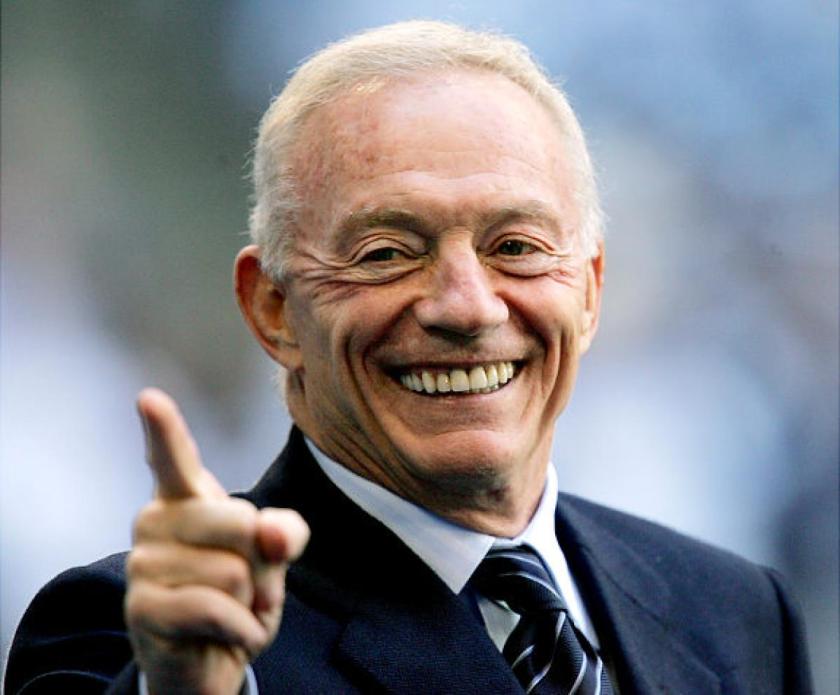
The very idea makes me want to weep into my pillow and also it’s perfect.  In a season as depressing as this one has been, what better way to punctuate it, what better kick in the collective football fan’s groin, than a Dallas Cowboys Super Bowl?  What could possibly make you hate yourself more, make you feel worse to be a football fan than Roger Goodell has made you feel over the last year, than to have the final image of this putrid season be Jerry Jones hoisting the Lombardi Trophy?  The symbolism is so glorious that I can’t tell whether I should root for it or throw up into my shoes.

The best/most horrible part is: it’s remarkably plausible.

The commentary surrounding the league’s transition to a vertical passing offense, and the ease with which teams can throw the ball, has become ubiquitous and boring (and just about all of it, obviously, absolutely true), but still overlooked is the cliched importance of rushing and defense in the playoffs, when the measure of success is winning one game against one opponent, and moving on to do it again.  Super Bowl champions of the last five years have had notoriously atrocious rushing attacks, with one exception — last year’s Seahawks, who also happen to be the Cowboys biggest challenger in the NFC this year.  It’s absolutely true that teams in recent history have been able to win Super Bowls with nothing better than a Brandon Jackson/John Kuhn (read: sack of potatoes) tag-team running game, but DeMarco Murray’s presence equips the Cowboys to outmatch this year’s competition.  It’s reductive to say that the one of the easiest ways to beat the Packers is to keep the ball out of Aaron Rodgers’ hands, but it’s also a pretty certain truth.  In Green Bay’s four losses this season, they’ve lost TOP by an average of 9 minutes/game.  DeMarco Murray’s roughly eight thousand rushing attempts have helped Dallas top the league in overall and average time of possession, controlling an average of 55% of each game.  In their Week 6 victory against Seattle, Dallas dominated TOP — 37 / 22, they shut down Russell Wilson, and DeMarco had 115 and a touchdown against the league’s 3rd-ranked rushing defense.  More than Detroit, with its frequently-injured offensive superstars and its easily-imploded defensive personalities; more than Arizona, with its Wednesday Night Taco League quarterbacks; maybe even more than Green Bay, with its in this case notable inability to defend the rush; this Dallas team is equipped for a literal and figurative run.

The biggest fear that Cowboys fans probably have, at this point, is that they miss the NFC Championship Game by some very Cowboys-y Romo-y catastrophe, and the front office in early February sounds something like this:

Team Exec: Hey, Jerry, whatcha got in that box there?

Jerry Jones: Nothing.

Team Exec: Are you sure?  It looks pretty heavy.  What’s your face doing?  You look like a pickled six hundred year old radish.

Jerry Jones: I am winking at you furtively so that you will leave right now and ask no further questions.  Who sent you here?  Was it Johnson?

Team Exec: It’s addressed to Minnesota…what the hell–

Jerry Jones: Get out of here!  Leave this place!!

Team Exec: Dammit Jerry this is every first round pick for the next eleven years-

Jerry Jones: Adrian!!!!

Team Exec: NOOOOOOO!!!

Jerry jones: ADRIAAAAN!!!!!!

Anything can happen, of course, but among the uncertainty lies two looming possibilities — we put this dismal season to bed with a long Cowboys run that will make us all hate ourselves for being football fans, or it comes to a colorless, predictable on-field end followed by Jerry fire-saling his team’s future in an extravagant display that will make us all hate ourselves for being football fans.  Sort of like the 2014 NFL season, this column has felt like a failed exercise in optimism.

In Defense of the Trop

Uncategorized

(originally published 6/26/13)

It’s an archaic above ground tomb done up in turquoise and taupe, dimly lit and claustrophobic, settled in a gloomy dissonance from the relative paradise upon which it is settled.  Its stony antiquation and lack of sentimentality are a matter of public record, its seafoam pallor ubiquitous, its universal lack of reverence a facet of almost any conversation involving the franchise it so tenuously houses.

So why am I here?

I’ve shown up at Tropicana Field in downtown St. Petersburg to see the Red Sox play the Rays in the opening game of a hugely consequential intra-divisional early-season series, with my beloved, visiting Sox in first place but vulnerable, the Rays only four games behind them in the loss column, in position to strike with three head-to-head duels upcoming, and on this night with their stud young pitcher Alex Cobb starting the game, the future of their rotation on display.  The budding rivalry between these two teams, among the winningest in baseball over the last seven years, has become electric and tense, with the Rays, at times against all odds and expectation, refusing to back the hell off, already.  It was a big fucking game.

And the place was empty.

The final, announced crowd was 15,000, roughly 45% of the Trop’s meager capacity and most of them supporting the Sox, with small huddled groups of fans tapering into thin blotches as the stands rose toward the slanted dome ceiling – a sobering backdrop to the magnitude of the competition set to commence.

Say what you want, and likely you at one time or another already have, about the dreary color and the weak verisimilitude of the field turf and the peeling paint and the chilling vulnerability of the bullpens — which look like they were squeezed into the equation haphazardly when some bleary eyed engineer noticed while studying the blueprints in a drunken predawn stupor that they’d been strangely omitted from the initial design – the worst part of the stadium aesthetics are those Oceanus expanses of empty sea-blue seats.

So why weren’t you there?

The arguments have been so longstanding and pervasive and fucking tired that we’re already aware of the full record of antagonism and weird militant hostility between the Tampa Bay area and the Trop.  The debate has been aired with such belligerence and intensity that even fans outside of the state of Florida, who have never been to the Trop and, based on what they’ve heard, will never have any desire to go, feel like they know the Rays fan’s plight like a horrifying tragedy passed among tattered and tyrannized generations – the traffic sucks and the building itself is impossible to find, the parking’s a nightmare, the population density of St. Pete is somewhere between the corporate offices of pets.com and the Gobi Desert, and by the way can you believe that on top of all that it is not nice to look at – and what’s so unsettling about the inescapable permeation of these arguments, their ingrained nature and the subsequent acceptance of the picture they paint as factual reality, is that none of those things are true.  Not one.  Not even a little.

The park is directly off of I-275, accessible by something like six highway exits (which accessibility I assure you again is real and does, in fact, reduce traffic density, and the “traffic is heavy between Tampa and St. Pete especially during rush hour” argument is so ludicrous that it is difficult for me to even type a rebuttal of it without wondering what planet I am even on and why are you making me do this – find me a metropolitan area, in which all ballparks abide, where traffic is not “heavy especially during rush hour.”  That place does not exist, and most other fan bases have no trouble jumping the traffic hurdle.  Even with subway systems and public transportation, the length and inconvenience of travel is basically a wash), there are about 14 sanctioned lots surrounding the ballpark not counting the public garages and etc that can be found in astounding frequency in the downtown St. Pete area, and if once leaving the highway you still somehow can’t locate the ballpark, I confidently submit that you are a demented crone who probably accidentally dropped his tickets into a blockbuster return slot and who even in your stupefied state if you are able to happen across the towering slanted dome structure, visible from blocks away and whose horizon-stamping vastness is the source of additional bewildering derision, will try to seek admission with six mistakenly toted copies of “Throw Mama From the Train” and a half a stick of gum.

I am getting stressed out by this, and I haven’t even gotten to the most physically painful, emotionally cringing argument of all.  Are there really fans, or “fans,” mingling among us who will refuse to see their favorite team, or I guess “favorite team,” because they don’t like the looks of the ballpark?  I can’t fathom this.  I don’t want to believe there are people in the world of sports fandom who can fathom this.  It would mean the erosion of what it even is to be a sports fan.

Let me debunk fifteen years of rumor hoax and hearsay with one simple unrecognized reality: Tropicana Field is a great place to watch a baseball game.  Not good.  Really fucking great.

Beautiful, historic stadiums are special, but I won’t be convinced that the lack of one in Tampa is the reason for a constantly low draw.

The capacity is a gentle 45,000-plus, with only one deck in right field and two in left, if you count the slim “Party Deck,” which provides for great sightlines and intimacy, even from the outfield “cheap seats” (which idiom can be comparatively applied in a literal capacity to most of the seating at the Trop, but we’ll get to that later); the ceiling, that ugly cement aspersion that you constantly for some reason hear about, meets the stands at a sharp enough angle on both base sides to create great sightlines perpendicular to home plate, even in the far reaches, which themselves, owing to that design, aren’t that far from the field, either.  It’s intimate.  It’s climate controlled.  It provides a covering shelter in a part of the world that erupts in apocalyptic monsoon only roughly every five minutes.  The concourse offers concessions not only in enough frequency and stocked with enough staples to satisfy the most corpulent and drooling among us, the layout is easy to navigate, almost as easy as the streets outside, and the food’s close enough to find, patronize, and depart in the brief interim between innings.  Simple enough stuff, right?  Sounds OK, right?

So why weren’t you there?

Have we gotten to a point where, as fans, this isn’t enough anymore?  In this post-New Yankee Stadium sports landscape, of the retractable cyborg roofs and the three dozen steakhouse concourse and the club level climate controlled lounge seating that inexplicably faces away from the field, is the simple experience of comfortably watching astounding levels of competition in close proximity not enough to draw us to the ballpark, even at comparatively dirt cheap prices?

It is unfathomable to me that stadium aesthetics can play such a role in a fan’s willingness to see a game.  Does the stuff you go to a ballpark to do really require some sort of pristine sanctuary?  I am picturing the typical baseball fan arriving at the park, his two-sizes-too-small-and-unwashed-for-reasons-of-superstition-and/or-loafen-slovenliness already besmirched by coalitions of liberated sandwich condiments fortified under the collar, patches of sweat and beer-dribble blotching the sleeve, as he looks down his nose in scrutiny of the spot that by inning three will be littered by his peanut shrapnel and nacho waste, saying “Nope, this compromises my delicately refined sensibilities.”  Ugh, man.

I don’t want to believe that the playing field is changing (sweet pun; suck it universe) – I don’t want to believe that our expectations as fans have risen so high that the experience of a live game itself isn’t enough.  That’s a perception that, as a sports fan, I’m not ready to accept.

And I don’t think I have to.

The Rays have the fourth lowest average ticket price in baseball, the fourth lowest Overall Fan Experience Cost, a talented, exciting, winning team, and the fifth lowest average attendance.

Why?

Rays fans can say that the economy sucks and they’ll come when they have more money, and to a degree, that’s fair.  But does the Tampa economy suck more than it does in Detroit?  Detroit is 5th in the league in 2013 attendance; the Rays are 26th, and it’s cheaper to watch a game in St. Pete than it is in Detroit.  The Rays, as of this writing, have only three fewer wins, so it’s difficult to blame the attendance disparity on a talent gap.

Is Tampa traffic worse than New York’s or Boston’s?  You’ll find 30,000 Yankee fans and 30,000 Sox fans who are willing to spend an hour and a half and three subway stops getting to Fenway Park or Yankee Stadium before you’ll find 10,000 Rays fans willing to hop on the highway for forty minutes and park thirty yards from the stadium.

There’s a lot of stuff to do in the Tampa area – there are more activities here than in many other places that vie for our time and attention.  We’re a conglomerate population with a lot of different ingrained rooting influences from our own native geographies.  It’s okay if the market doesn’t care enough about the Rays to properly support the team.  Lots of markets can’t support a professional franchise.  That’s not a knock; it’s just a reality.  But don’t blame the lack of allegiance on the stadium, and really, really don’t try to lobby for public financing for a waterfront park when you cannot fill what we’ve just determined is the perfectly suitable one you already have.  You want public financing for a new stadium?  So it can sit empty like Miami’s?

You told us you’d come when the team got better.  The team is really fucking good, and you’re still sitting at home.  Don’t tell us you’ll come when you have a new stadium.  We’ve heard this shit before.

Despite what they might tell you, Rays fans don’t have outlandish expectations — they don’t ignore their team because they want too much from their stadium.  They have a great stadium that they use as a scapegoat for their own lack of interest.

It’s cheaper to watch a game here.  And for all the frenzied whining, parking and travel is easier, too.

So why won’t you come?

It isn’t that there are too many needy Rays fans.  It’s that there aren’t enough Rays fans of any kind at all.

Think I’m wrong?  I’d tell you to check it out for yourself, but you probably decided long ago not to.